Functional health vs conventional medicine sets the stage for this enthralling narrative, offering readers a glimpse into a story that is rich in detail and brimming with originality. Functional Health and Conventional Medicine stand as two pillars in the healthcare realm, each approaching wellness from distinct perspectives.
As we delve deeper into the principles, diagnostic methods, treatment approaches, and patient-centered care of both paradigms, a fascinating journey unfolds, shedding light on the intricacies of healthcare practices.
Functional Health vs Conventional Medicine
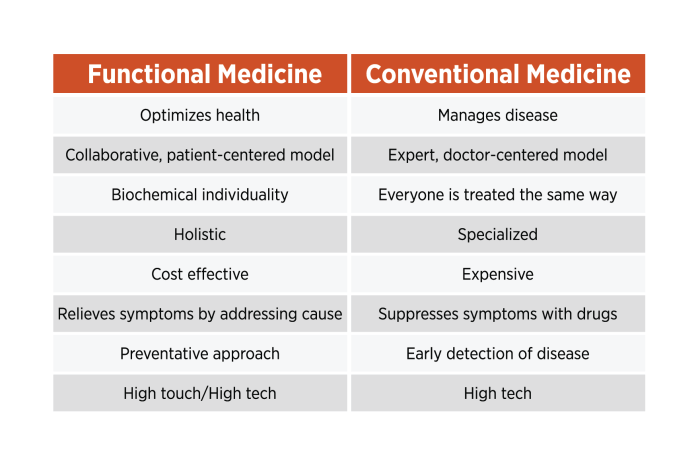
Functional Health focuses on addressing the root cause of health issues by looking at the body as a whole system, emphasizing prevention and lifestyle changes. On the other hand, Conventional Medicine typically treats symptoms with medication or surgery, focusing on specific areas of the body.
Key Differences
- Functional Health looks at the underlying causes of diseases, while Conventional Medicine treats symptoms.
- Functional Health emphasizes prevention through nutrition, exercise, and stress management, while Conventional Medicine relies more on pharmaceutical interventions.
- Functional Health practitioners spend more time with patients to understand their lifestyle and health history, whereas Conventional Medicine practitioners may have limited time for each patient.
Examples of Approaches
For example, if a patient presents with high blood pressure, a Functional Health practitioner may investigate possible causes such as diet, stress, or hormonal imbalances. They may recommend dietary changes, stress reduction techniques, and supplements to address the root cause.
In contrast, a Conventional Medicine doctor may prescribe medication to lower the blood pressure without necessarily addressing the underlying reasons for the condition.
Principles of Functional Health
Functional Health is based on several core principles that differentiate it from conventional medicine. One of the key principles is its focus on treating the root cause of illnesses rather than just addressing symptoms. This approach aims to identify the underlying factors contributing to health issues and work towards resolving them to achieve long-term health and wellness.
Treating the Root Cause
Functional Health practitioners believe that symptoms are manifestations of deeper imbalances within the body. By addressing these root causes, such as poor nutrition, hormonal imbalances, or inflammation, they aim to restore the body's natural equilibrium and promote healing from the inside out.
This personalized approach allows for more effective and sustainable results compared to simply masking symptoms with medications.
Personalized Treatment Plans
Another key principle of Functional Health is the emphasis on personalized treatment plans tailored to individual needs. Practitioners take into account each person's unique genetic makeup, lifestyle factors, and environmental influences to create customized strategies for improving health. This personalized approach ensures that the treatment addresses the specific needs of the individual, leading to better outcomes and overall well-being.
Approach to Diagnosis and Treatment
Functional Health and Conventional Medicine have distinct approaches when it comes to diagnosing and treating health issues. Let's delve into the differences in their methodologies and how they approach treatment plans.
Diagnostic Methods
In Conventional Medicine, diagnosis often relies heavily on lab tests, imaging studies, and physical examinations to identify specific diseases or conditions. These methods are crucial for determining the root cause of symptoms and guiding treatment decisions. On the other hand, Functional Health practitioners take a more holistic approach to diagnosis.
They look at the body as a whole system and focus on identifying underlying imbalances or dysfunctions that may be contributing to a patient's symptoms. This approach often involves in-depth consultations, detailed health histories, and specialized tests that assess various aspects of a person's health, such as hormonal levels, gut function, and nutrient deficiencies.
Treatment Plans
When it comes to treatment plans, Conventional Medicine typically involves the use of pharmaceuticals, surgeries, or other invasive procedures to manage or alleviate symptoms. While these interventions can be effective in many cases, they often target the symptoms rather than addressing the root cause of the problem.
Functional Health, on the other hand, emphasizes personalized and integrative treatment plans that aim to restore balance and optimize health. This may involve dietary modifications, supplementation, stress management techniques, and other lifestyle changes that support the body's natural healing processes.
By addressing underlying imbalances, Functional Health practitioners strive to promote long-term wellness and prevent future health issues.
Incorporating Lifestyle Changes
One of the key aspects of Functional Health is the integration of lifestyle modifications into treatment plans. Practitioners often emphasize the importance of diet, exercise, sleep, and stress management in achieving optimal health outcomes. By empowering patients to make sustainable lifestyle changes, Functional Health aims to not only alleviate current symptoms but also prevent future health issues from arising.
This approach recognizes the interconnectedness of various aspects of health and focuses on promoting overall well-being through holistic interventions.
Patient-Centered Care
Functional Health places a strong emphasis on patient-centered care, prioritizing the individual's unique needs, preferences, and goals in the healthcare journey. This approach ensures that patients are actively involved in decision-making processes regarding their health and well-being.
Involving Patients in Decision-Making
Functional Health practitioners engage patients in the decision-making process by taking the time to listen to their concerns, values, and goals. They work collaboratively with patients to develop personalized treatment plans that align with the individual's lifestyle and preferences. By actively involving patients in the decision-making process, Functional Health practitioners empower individuals to take charge of their health and make informed choices.
Doctor-Patient Relationship in Functional Health
The doctor-patient relationship holds significant importance in Functional Health, as it forms the foundation of personalized care. Functional Health practitioners prioritize building strong and trusting relationships with their patients, creating a supportive environment where open communication and shared decision-making thrive.
This close relationship allows practitioners to gain a deeper understanding of the patient's health history, concerns, and goals, leading to more effective and personalized treatment plans tailored to the individual's needs.
Concluding Remarks
In conclusion, the divergent paths of Functional Health and Conventional Medicine reveal the evolving landscape of healthcare. While one focuses on personalized, root cause-based treatments, the other follows traditional diagnostic and treatment protocols. The interplay between these contrasting approaches underscores the complex nature of healthcare delivery, emphasizing the importance of individualized care for optimal wellness.
Clarifying Questions
What is the fundamental difference between Functional Health and Conventional Medicine?
Functional Health emphasizes treating the root cause of illnesses, while Conventional Medicine typically focuses on symptom management.
How do Functional Health practitioners involve patients in their treatment plans?
Functional Health practitioners prioritize patient-centered care by actively involving patients in decision-making processes regarding their health.
Do Functional Health and Conventional Medicine differ in their approach to lifestyle changes?
Functional Health often incorporates lifestyle changes as part of treatment plans, whereas Conventional Medicine may not emphasize this aspect as prominently.